
 English
 Français
 Español
 日本語
 العربية
 简体中文


Is DOT Certification Mandatory in the United States? Requirements and Compliance Process
Is DOT Certification Mandatory in the United States? Requirements and Compliance Process
The U.S. Department of Transportation (DOT) establishes federal transportation safety policies and oversees various transportation-related agencies. For motor vehicle safety, the National Highway Traffic Safety Administration (NHTSA), an agency within the DOT, is responsible for issuing and enforcing Federal Motor Vehicle Safety Standards (FMVSS).
In the United States, manufacturers of motor vehicles and certain regulated motor vehicle equipment must ensure that their products comply with all applicable FMVSS requirements before they are introduced into the market.
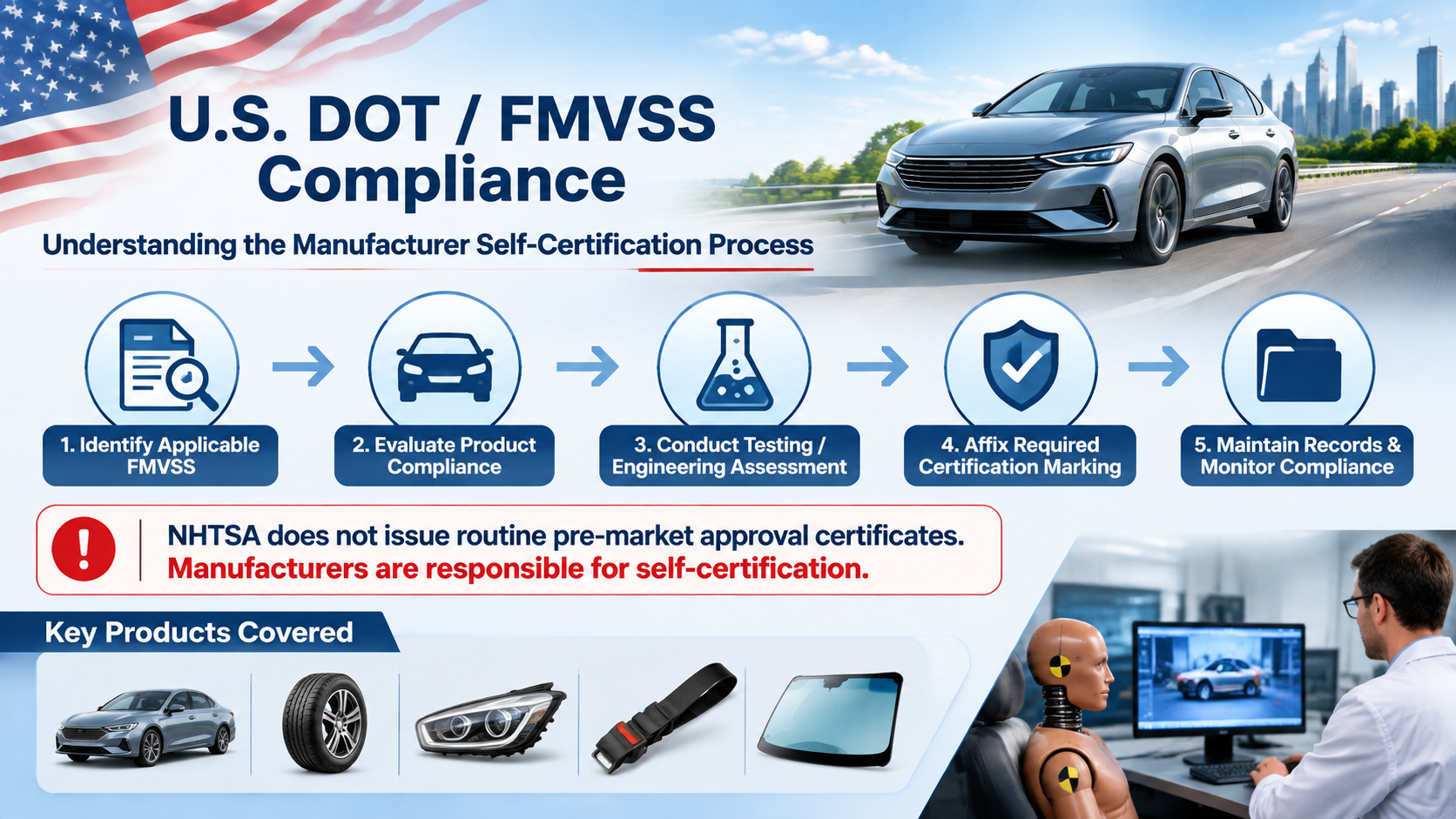
The U.S. system is based on manufacturer self-certification, rather than a conventional government pre-approval process. Manufacturers are responsible for verifying compliance and applying the required certification labels or markings.
Is DOT Certification Mandatory?
Compliance with applicable FMVSS requirements is mandatory for motor vehicles and regulated motor vehicle equipment covered by the relevant federal safety standards.
However, it is important to understand that the term "DOT Certification" is commonly used in the industry as a general expression. The United States does not operate a conventional DOT type-approval system in which manufacturers submit applications to NHTSA and receive government-issued certificates before selling their products.
Instead, manufacturers must:
Identify all FMVSS requirements applicable to their products.
Establish an appropriate basis for determining compliance.
Ensure that their products meet the relevant safety requirements.
Apply the required certification labels or markings.
Fulfil applicable post-market reporting, recordkeeping and compliance obligations.
Products that are subject to applicable FMVSS requirements cannot legally be manufactured for sale, sold, offered for sale or imported into the United States unless the relevant requirements are met.
Products Covered by DOT / FMVSS Requirements
FMVSS requirements apply to specified categories of motor vehicles and certain items of motor vehicle equipment. The applicable standards depend on the product type and its intended use.
Common examples include:
1. Motor Vehicles
Passenger cars
Trucks and commercial vehicles
Multipurpose passenger vehicles
Buses
Trailers and other regulated vehicle categories
2. Motor Vehicle Equipment
Tires
Automotive lighting equipment
Seat belts and restraint systems
Motorcycle helmets
Motor vehicle glazing materials
Other safety-related vehicle components covered by specific FMVSS requirements
Not every automotive accessory or component is automatically subject to a separate FMVSS certification requirement. Manufacturers should determine the applicable standards based on the product's classification, function and intended application.
Aircraft and marine vessels are not generally covered by the motor vehicle FMVSS framework. They are subject to separate regulatory systems and requirements.
U.S. DOT / FMVSS Compliance Process
Unlike traditional type-approval systems, the U.S. compliance framework does not generally require manufacturers to obtain a pre-market approval certificate from NHTSA. The manufacturer is responsible for demonstrating and certifying compliance.
The process can generally be organized into the following stages:
1. Identify Applicable FMVSS Requirements
The manufacturer first needs to determine how the product is classified and which Federal Motor Vehicle Safety Standards apply.
Different products are subject to different technical requirements. For example, requirements for tires, vehicle lighting, seat belts and glazing materials are specified under different FMVSS regulations.
2. Conduct a Compliance Assessment
The manufacturer should review the applicable technical requirements and evaluate whether the product design, materials, construction and performance meet the relevant safety standards.
An appropriate compliance assessment may involve engineering analysis, design review, testing or a combination of these methods.
3. Perform Testing and Verification
Manufacturers are responsible for establishing a reasonable basis for their compliance determination.
Testing is an important way to verify product performance. Depending on the applicable standard and product characteristics, manufacturers may arrange testing through qualified independent laboratories or conduct suitable internal evaluations.
NHTSA does not generally require manufacturers to use a specific U.S.-based laboratory for their own compliance assessment. The manufacturer remains responsible for ensuring that the product would comply when evaluated by NHTSA.
4. Apply the Required Certification Label or Marking
Once the manufacturer has determined that the product complies with all applicable requirements, it must provide the required certification statement, label or marking in accordance with the relevant regulations.
For motor vehicles, the manufacturer generally affixes a permanent certification label stating that the vehicle conforms to all applicable FMVSS in effect on the date of manufacture.
For regulated motor vehicle equipment, marking requirements vary according to the relevant standard and product category. Certain products, such as tires and glazing materials, have specific identification and marking requirements.
5. Maintain Compliance and Prepare for NHTSA Surveillance
Manufacturers must continue to ensure that their products comply with applicable requirements.
NHTSA's Office of Vehicle Safety Compliance (OVSC) conducts compliance testing and other enforcement activities. The agency may select vehicles or equipment from the market and evaluate them against the applicable FMVSS.
If a noncompliance or safety-related defect is identified, manufacturers may be required to notify affected parties, conduct a recall and provide an appropriate remedy.
Important Considerations for Foreign Manufacturers
Foreign manufacturers intending to export motor vehicles or regulated motor vehicle equipment to the United States should pay particular attention to the following requirements:
U.S. Agent Designation: Foreign manufacturers of motor vehicles and motor vehicle equipment must designate an agent for service of process in the United States before offering their products for importation, as required under 49 CFR Part 551, Subpart D.
Applicable Standards: Manufacturers must identify the FMVSS requirements relevant to each product category and configuration.
Compliance Evidence: Appropriate technical documentation, test data and engineering assessments should be maintained to support the manufacturer's compliance determination.
Certification Marking: Products must carry the applicable certification labels or markings in accordance with the relevant regulations.
Post-Market Responsibilities: Manufacturers should establish procedures for monitoring product compliance and handling potential safety defects or noncompliance issues.
Conclusion
U.S. DOT / FMVSS compliance is a mandatory market-access requirement for motor vehicles and regulated motor vehicle equipment covered by the applicable federal safety standards.
However, the U.S. system differs from conventional type-approval models. NHTSA does not routinely issue pre-market approval certificates. Instead, manufacturers are responsible for self-certifying that their products comply with all applicable FMVSS requirements.
For manufacturers planning to enter the U.S. automotive market, identifying the correct standards, conducting appropriate compliance assessments and ensuring proper certification marking are essential steps toward meeting U.S. vehicle safety requirements.
 博客
Is DOT Certification Mandatory in the United States? Requirements and Compliance Process
閱讀文章
 博客
BIS Mandatory ISI Mark Certification: An Overview of the Process and Requirements
閱讀文章
 博客
GB 36672-2026: What Electric Motorcycle Battery Manufacturers Need to Prepare Before July 20
閱讀文章
 博客
UL Certification: Process, Product Categories and Certificate Validity
閱讀文章
博客
Your Automotive Component Is Already Approved. Can You Change the PCB, Antenna or Supplier W
閱讀文章
 認證指南
CE RED 認證指南:要求、流程與週期
閱讀文章

 4000259520