
 English
 Français
 Español
 日本語
 العربية
 简体中文


GSO 2693:2026 Is Now Here. Does Your Existing DAB+ Test Report Still Cover the New GCC Requirement?
GSO 2693:2026 Is Now Here. Does Your Existing DAB+ Test Report Still Cover the New GCC Requirement?
You already have a DAB+ test report.
The product has been tested.
The report is complete.
Your engineering team wants to ship.
Then a new question appears:
“GSO 2693:2026 is now published. Can we still use our existing DAB+ test report for the GCC market?”
This is not a simple yes or no.
And I would strongly advise manufacturers not to start another full test campaign before checking whether the existing evidence is still technically usable.
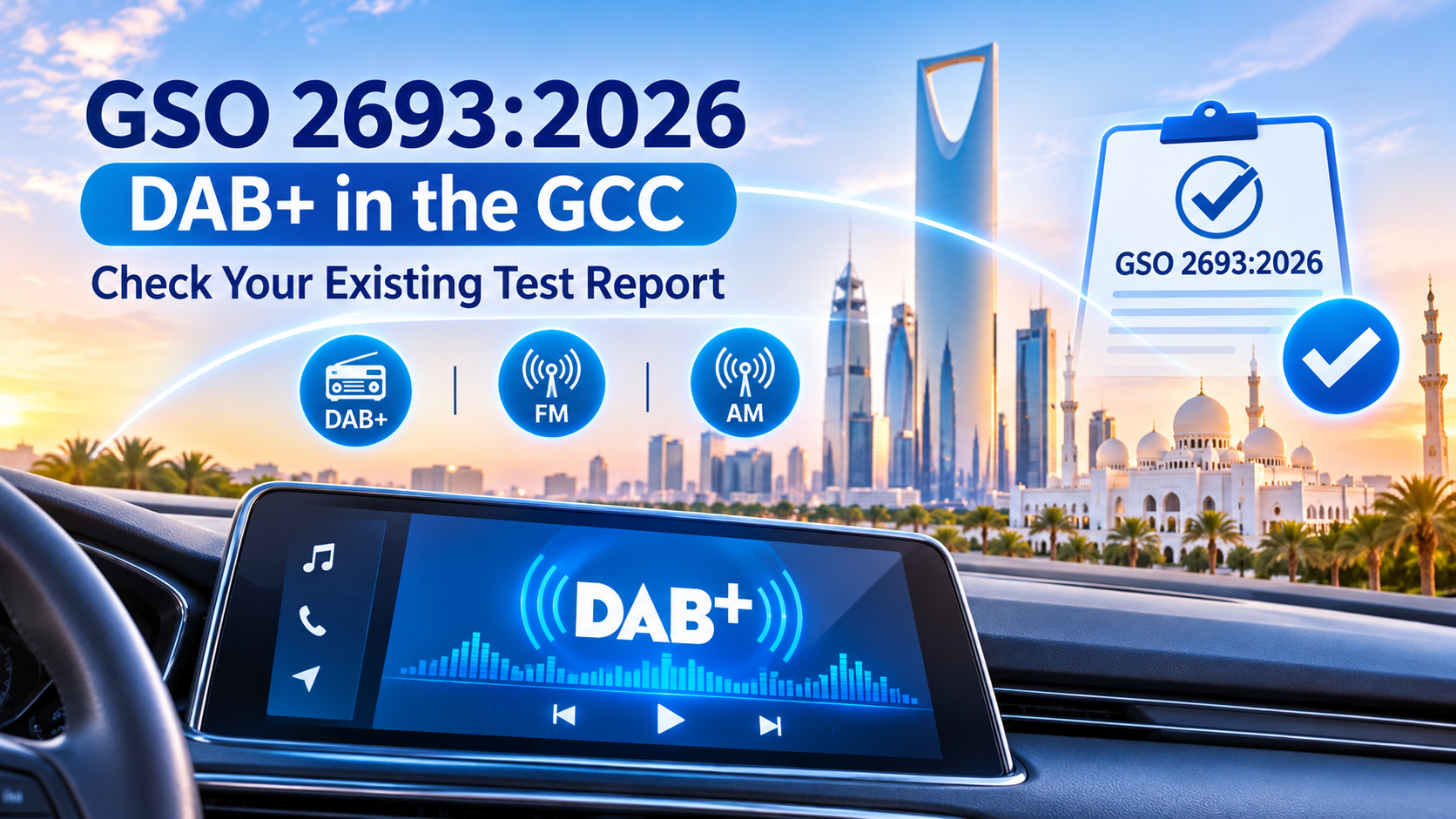
In April 2026, the Gulf Standardization Organization published GSO 2693:2026 — The GCC Terrestrial Radio Receiver Specifications for AM/FM/T-DAB+. The specification covers radio receivers and products with built-in radio receivers sold in GCC countries, including vehicle-integrated receivers, aftermarket receivers and multi-function products.
So the real compliance question is:
Does your existing test evidence match the product, configuration, test requirements and GCC market you are targeting?
A New Standard Does Not Automatically Mean “Retest Everything”
This is one of the most common mistakes in international compliance projects.
When a new standard or revised technical specification appears, companies often make one of two assumptions:
Assumption 1
“Our old report is no longer valid. We need a completely new test.”
Assumption 2
“Our old report already proves DAB+ compliance. Nothing needs to change.”
Both can be wrong.
A better approach is:
Existing Report
↓
GSO 2693:2026 Requirements
↓
Gap Assessment
↓
Reuse / Supplementary Testing / Full Retest
The objective is to identify the minimum additional evidence actually required.
What Changed With GSO 2693:2026?
The important point is not simply the document number.
The scope is broad.
GSO 2693:2026 covers products capable of receiving terrestrial:
AM + FM + T-DAB+
It also covers products that have other functions in addition to radio reception.
For automotive manufacturers, this is particularly important because the scope includes:
Vehicle-integrated receivers
Dashboard-integrated receivers
Aftermarket receivers
Multi-function infotainment products
Other products with built-in terrestrial radio receivers
So an automotive infotainment system should not be excluded simply because:
“DAB+ is only one function of the product.”
That is exactly the type of product that needs to be reviewed carefully.
Your Existing DAB+ Report: 10 Questions to Ask
Before booking another test, I recommend reviewing the existing report against these ten points.
1. Is the Product Scope the Same?
Is the tested product actually the product being shipped?
For example:
Standalone DAB+ receiver
versus
Vehicle infotainment system with AM/FM/DAB+
The product architecture matters.
2. Is the Hardware Configuration the Same?
Check:
Main chipset
RF front end
DAB+ module
PCB
Antenna interface
Power supply
Audio path
A report for an earlier hardware version should not automatically be treated as evidence for the production version.
3. Is the Antenna Configuration the Same?
This is especially important for automotive products.
Check:
Antenna type → Gain → Location → Cable → Connector → RF path
A DAB+ receiver report cannot tell the whole story if the production antenna configuration has changed significantly.
4. Is the Firmware the Same?
DAB+ performance can involve software-controlled functions such as:
Station scanning
Service selection
Service linking
Signal recovery
Display information
Switching behavior
If the firmware has changed, determine whether the change affects the tested characteristics.
5. Were the Same AM/FM/T-DAB+ Functions Tested?
GSO 2693:2026 covers terrestrial AM, FM and T-DAB+ reception.
Therefore, don't look only for the words:
“DAB+ passed.”
Check exactly which receiver functions and operating modes were included in the existing evidence.
The DAB+ Report Reuse Decision Matrix
This is the type of matrix I recommend manufacturers create before deciding whether to retest.
| Item | Existing Report | Production Product | Assessment |
|---|---|---|---|
| Product type | Same | Same | ✓ |
| Hardware | Same | Same | ✓ |
| DAB+ receiver | Same | Same | ✓ |
| Antenna | Different | New antenna | Gap |
| Firmware | Different | New FW | Review |
| AM/FM | Tested | Required | Review |
| T-DAB+ | Tested | Required | ✓ |
| Test method | Previous | GSO 2693:2026 | Compare |
| Market | Previous GCC scope | Target GCC country | Review |
| Production configuration | Previous | New | Review |
The final decision should then be:
Reusable Evidence
or
Supplementary Testing
or
Full Retest
The key is that this decision should be based on technical evidence, not simply the age of the report.
One Report Does Not Necessarily Mean One GCC Market
This is another area where automotive exporters need to be careful.
GSO 2693:2026 creates greater harmonization across the GCC, but individual market requirements and implementation arrangements still need to be checked.
For example, Saudi Arabia has existing requirements under SASO 2938:2019, while the UAE has its own mandatory UAE.S 5021:2018 framework for terrestrial radio receivers.
The GCC technical-regulation landscape is therefore moving toward greater alignment, but manufacturers should not assume:
“One DAB+ report automatically equals every country's final market-access requirement.”
Instead, build a market matrix:
Country → Applicable Requirement → Product Scope → Test Method → Existing Evidence → Gap → Required Action
This is particularly important for manufacturers exporting the same infotainment platform into Saudi Arabia, UAE, Oman, Qatar, Kuwait and Bahrain.
Oman Makes This Even More Relevant
Oman announced an update related to GSO 2693:2026 in July 2026, in coordination with its Ministry of Information, Telecommunications Regulatory Authority and Ministry of Defence.
This is a useful signal for manufacturers:
Don't treat GSO 2693:2026 as a document that only matters when the next vehicle certification project starts.
The GCC market is actively moving toward a more unified technical framework for terrestrial radio receivers.
If your product roadmap includes GCC export, it is better to review the evidence before production configuration is frozen.
What About Aftermarket DAB+ Products?
This is especially important for aftermarket manufacturers.
GSO 2693:2026 explicitly includes aftermarket receivers mounted in locations such as the dashboard, behind the dashboard or on the windscreen.
For these products, the compliance review should consider both:
Product-Level Evidence
DAB+ receiver
AM/FM
RF performance
Firmware
Audio
User interface
Installation Configuration
Antenna position
Antenna cable
Grounding
Vehicle environment
Power supply
RF interference
This distinction matters because a receiver can pass a laboratory test while the installed vehicle configuration performs differently.
The aftermarket industry itself emphasizes the importance of correct antenna positioning and cabling for good in-vehicle DAB+ reception.
Don't Forget the Production Configuration
Imagine this situation:
Your test report was issued for:
DAB+ Module A + Antenna A + Firmware V1.0
But production uses:
DAB+ Module A + Antenna B + Firmware V2.3
The product name has not changed.
The enclosure has not changed.
The customer sees the same infotainment screen.
But the technical configuration is no longer identical.
This is why compliance teams should maintain a:
DAB+ Compliance Configuration Baseline
Product Model
→ Hardware Revision
→ DAB+ Module
→ Antenna
→ RF Path
→ Firmware
→ AM/FM/DAB+ Function
→ Test Report
→ Applicable GCC Requirement
→ Market
→ Production Version
This makes future report reuse much easier.
What Manufacturers Should Do Now
If you already have a DAB+ report, I recommend this sequence:
Step 1
Collect the existing test report and production configuration.
Step 2
Identify the exact requirements applicable to your target GCC markets.
Step 3
Map the existing report against GSO 2693:2026 and relevant national requirements.
Step 4
Check hardware, antenna, firmware and test-method differences.
Step 5
Classify each item:
Covered / Partially Covered / Not Covered
Step 6
Only then decide:
Reuse → Supplement → Retest
This can prevent both unnecessary testing and last-minute compliance gaps.
How BlueAsia Can Help
DAB+ is one of BlueAsia's core automotive compliance capabilities.
We work with:
Automotive OEMs
Infotainment manufacturers
Head-unit suppliers
Aftermarket DAB+ brands
Automotive electronics manufacturers
Vehicle connectivity developers
GCC market exporters
Our DAB+ work can combine:
DAB+ Testing
RF / EMC
Antenna & RF Path Review
Automotive Electronics Validation
GCC Compliance Assessment
Existing Report Gap Analysis
The objective is not simply to issue another report.
It is to answer a more valuable question:
“What evidence do we already have, what can we reuse, and what is actually missing for our target GCC market?”
The Question I Would Ask Before Ordering Another Test
If your company already has a DAB+ report, don't start with:
“How much will the new test cost?”
Start with:
“Does our existing evidence still represent the product we are going to sell, under the requirements applicable to the GCC market we are entering?”
If yes, reuse it where technically justified.
If there is a gap, test the gap.
If the configuration has fundamentally changed, then consider a broader retest.
GSO 2693:2026 is a reason to review your evidence—not automatically a reason to throw your old evidence away.
If you are preparing an AM/FM/T-DAB+ automotive infotainment or aftermarket product for GCC markets, BlueAsia can help you map your existing reports against the applicable requirements and identify the most efficient validation path before you spend on unnecessary testing.
 博客
Why Smart Cockpit Projects Fail Because Of System Integration—Not Hardware
閱讀文章
 博客
Why Passing Android Auto Doesn't Mean Your Connectivity System Is Ready
閱讀文章
 博客
Can R155/R156 Evidence Be Reused Across Vehicle Categories?
閱讀文章
 博客
GSO 2693:2026 Is Now Here. Does Your Existing DAB+ Test Report Still Cover the New GCC Requi
閱讀文章
 博客
Why Software Updates Are Creating Supplier Management Challenges
閱讀文章
 博客
Why Certification Engineers Need to Think Like System Architects
閱讀文章

 4000259520